You did everything right. You put your phone away, went to bed on time, and got a full eight hours of sleep. Yet somehow, by 10 a.m., you’re already reaching for your third cup of coffee and counting down the hours until you can lie down again. If you feel sleepy even after 8 hours of sleep, you’re not imagining it, and you’re definitely not alone. The confusing part is that “enough sleep” was supposed to fix this. So why doesn’t it?
The honest answer is that eight hours on the clock and eight hours of real rest are not always the same thing. What you’re experiencing could be burnout quietly draining your reserves, a lifestyle pattern keeping your energy low, or a physical cause your body has been trying to flag for a while. This blog walks through all three possibilities, so you can stop guessing and start figuring out what’s actually going on.
Why You Still Feel Sleepy Even After 8 Hours of Sleep
Most advice around tiredness starts and ends with “sleep more”. But if you already sleep a full 8 hours and still wake up groggy, more sleep isn’t the missing piece; something else is competing for your energy.
Sleep quality depends on far more than just hours logged. Frequent light-sleep interruptions, an inconsistent bedtime, screen exposure before bed, or an undiagnosed sleep disorder can all leave you technically “rested” on paper but running on empty in real life. Sleep Foundation research found that nearly half of American workers report feeling tired during the day, and roughly seven in ten feel exhausted by the time their workday ends, evidence that clocking hours alone rarely solves persistent tiredness.
A separate population study published through the National Institutes of Health found that adults getting six hours of sleep or less were roughly two and a half times more likely to report frequent mental distress compared to those sleeping longer, a reminder that sleep and mental fatigue are closely linked, even when your total hours look adequate on paper.
So if you feel sleepy even after 8 hours of sleep on a regular basis, it’s worth looking past your sleep schedule and asking what else might be pulling your energy down.
Could It Be Burnout?
Burnout isn’t just an occupational hazard for people in high-stress jobs anymore; it’s become closer to the norm than the exception. Recent workplace research puts burnout among employees well above half, with a large share reporting moderate to severe symptoms rather than an occasional rough week. Burnout builds slowly: constant deadlines, blurred boundaries between work and rest, and a mind that never fully switches off, even during sleep.
Common signs of burnout include:
1. Feeling emotionally drained before the day even starts
2. Struggling to concentrate on tasks that used to feel easy
3. A shorter fuse with people you’re usually patient with
4. Sleeping the recommended hours but waking up feeling like you never rested
5. A creeping sense of detachment from work or personal goals
If several of these sound familiar, your body may already be showing burnout symptoms, even if your calendar looks “normal” on paper. We’ve written in more depth about, (what emotional exhaustion looks like) day-to-day and why it doesn’t always come from an obvious source. It’s worth a read if this section feels close to home.
It’s worth noting that burnout rarely announces itself all at once. Most people describe it as a slow fade, where motivation, patience, and energy all quietly decline over weeks or months until “tired” becomes the default, not the exception.
Or Is It Simply Low Energy?
Not every case of persistent tiredness is burnout. Sometimes it’s simpler and more fixable than that. Low energy causes are often lifestyle-driven: skipped meals, blood sugar crashes, too little movement during the day, dehydration, or a diet that isn’t giving your body what it needs to sustain steady energy.
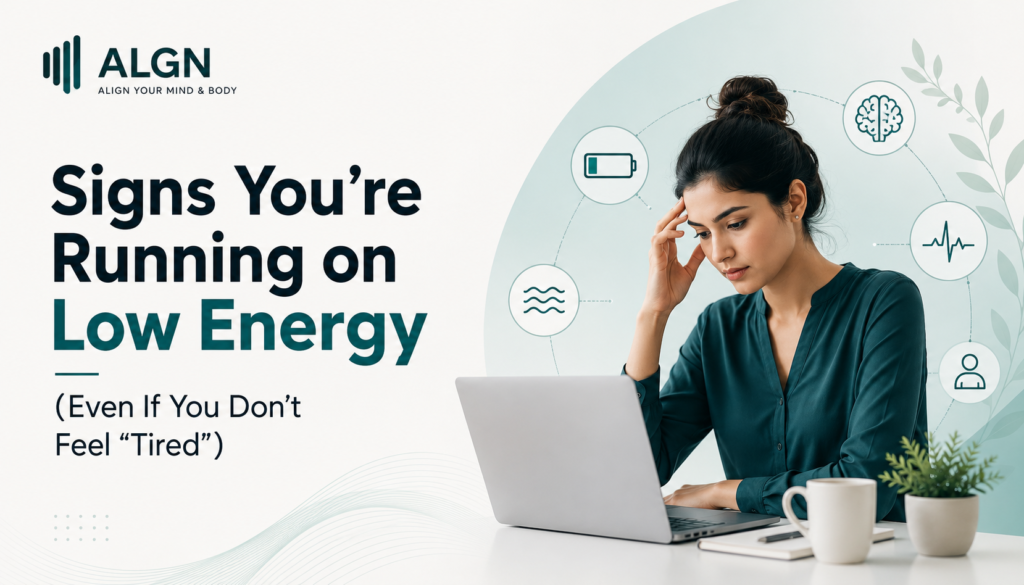
If you feel sleepy even after 8 hours of sleep but the rest of your day feels physically flat rather than emotionally heavy, low energy is often the simpler explanation. Unlike burnout, low energy doesn’t usually come with the same emotional heaviness of dreading your day. It shows up more physically: an afternoon crash, needing caffeine to function, or feeling like you’re running on a battery that never fully charges. If this description feels closer to your experience, our guide on the signs you’re running on low energy, even if you don’t feel outright “tired”, breaks down exactly how to tell the difference.
The good news with lifestyle-driven low energy is that small, consistent changes, like more stable meal timing, better hydration, and short movement breaks through the day, tend to show results faster than most people expect.
Or Is It Something More?
If you’ve ruled out an obvious stress pattern and your habits are reasonably solid, and you still feel sleepy even after 8 hours of sleep, it may be time to look at physical causes. Cleveland Clinic notes that anaemia and vitamin deficiencies, particularly low vitamin D or B12, are among the most common medical reasons behind ongoing fatigue. Mayo Clinic also lists thyroid problems, depression, diabetes, heart disease, and even long COVID as conditions that can quietly drain your energy, sometimes with sleepiness as one of the only early signs.
Other possibilities worth ruling out:
1. An underactive thyroid (hypothyroidism), which slows metabolism and energy production
2. Iron-deficiency anaemia, which limits how much oxygen reaches your tissues
3. Undiagnosed sleep apnea, where breathing interruptions prevent deep, restorative sleep even after a full night in bed
4. Chronic dehydration or an untreated vitamin deficiency
None of this is meant to alarm you; most of these causes are manageable once identified. But if fatigue has lasted more than a few weeks despite decent sleep and lower stress, it’s worth getting basic bloodwork done rather than assuming it will pass on its own.
How to Actually Find Out What’s Draining You
If you feel sleepy even after 8 hours of sleep for more than a few weeks, self-diagnosing rarely works well, since burnout, low energy, and medical causes can look nearly identical on the surface. A more reliable approach looks like this:
1. Track your sleep and energy for a week, noting what time you slept, how you felt on waking, and your energy dips through the day.
2. Rule out the basics: hydration, meals, and screen time before bed.
3. Get a simple blood panel if fatigue persists beyond three to four weeks despite good sleep hygiene.
4. Talk to someone qualified about stress load if the tiredness feels more emotional than physical.
This is exactly the kind of pattern Dr Upasana Singh helps people untangle, because guessing at the cause usually means guessing at the fix too. Rather than treating symptoms in isolation, it starts with understanding whether the root issue is emotional, physical, or a mix of both.
How ALGN’s Doctor-Led Approach Helps
ALGN’s programmes are built specifically for people who are tired or feel sleepy even after 8 hours of sleep – “Just get more sleep” advice that doesn’t address what’s actually going on. Every protocol starts with understanding your real biology, stress load, nutrition gaps, recovery habits, and, where relevant, medical history, instead of applying a one-size-fits-all fix.
If your fatigue is tied to stress and burnout rather than a physical cause, you can book a free 15-minute consultation with Dr Upasana Singh and the ALGN health coach to talk through what’s actually happening before deciding on next steps.
Feeling sleepy even after 8 hours of sleep isn’t something you have to accept as your new normal. Whether it turns out to be burnout, low energy, or a medical cause you haven’t checked for yet, the way forward starts with figuring out which one it actually is, not guessing and hoping it fixes itself.
Frequently Asked Questions
1. Why do I feel sleepy even after 8 hours of sleep?
It usually comes down to sleep quality rather than sleep quantity. Fragmented sleep, high stress levels, or an underlying condition like anaemia or a thyroid issue can all leave you tired even after a full night in bed.
2. Is it normal to feel tired all day even with enough sleep?
It’s common, but not something to permanently accept. Large-scale workplace surveys show a significant share of adults report daytime tiredness despite sleeping, which usually points to an unaddressed stress, lifestyle, or medical factor.
3. What are the signs of burnout versus simple tiredness?
Burnout tends to come with emotional exhaustion, irritability, and detachment from things you usually care about, not just physical sleepiness. Simple tiredness usually improves with rest; burnout often doesn’t.
4. Can a vitamin deficiency cause fatigue even with good sleep?
Yes. Low vitamin D, B12, or iron levels are common, correctable causes of persistent fatigue, and a simple blood test can confirm whether this is a factor for you.
5. How long should I wait before seeing a doctor about constant fatigue?
If fatigue continues for more than three to four weeks despite consistent sleep and reasonable stress levels, it’s worth getting it checked rather than waiting it out.
6. Can stress alone make me feel exhausted even after resting well?
Yes. Chronic stress keeps your body’s cortisol and nervous system activated even during sleep, which is why you can wake up from a full night’s rest still feeling drained.
7. Is it possible to feel sleepy even after 8 hours of sleep because of sleep apnoea?
Yes. Sleep apnoea interrupts breathing repeatedly through the night, preventing deep, restorative sleep even if you’re technically in bed for a full eight hours. A sleep study can confirm whether this is the cause.